Disease language through tongue
Lectures and practical workshops
Exploring the methods of Chinese medicine, with an emphasis on tongue observation
I, Konstantin Medragon, invite you to delve into the practice of self-observation through the lens of millennia-old wisdom. This course is dedicated to developing the skill of attentive "reading" of the body's signals.
What we explore together
- The tongue as a map of health
- The art of self-observation
- Recognizing early signs of imbalance
As Wang Bing commented on the Huangdi Neijing:
"The superior physician observes and knows. The average physician asks and knows. The inferior physician feels the pulse and knows."
This course focuses on cultivating that highest skill – observation (望診, Wàng Zhěn).
The essence of this journey
- Immersion in principles from ancient texts
- A seminar built on collaborative exploration
- In-depth study of the tongue as a diagnostic mirror
- Knowledge for personal awareness and well-being
The four examinations in Chinese medicine (四诊)
1. Inspection (望诊)
- Facial complexion. Each element corresponds to a specific hue (e.g., yellowish/earthy - Earth (Spleen) imbalance; bluish - Wood (Liver)).
- Tongue diagnosis (舌诊). A key method.
- Tongue body: Color (pale - Blood/Qi/Yang deficiency; red - Heat/Yin deficiency), shape (swollen - Dampness/Spleen Yang deficiency; thin - Blood/Yin deficiency), tooth marks (Dampness/Spleen Qi deficiency).
- Tongue coating: Color (white - Cold/Dampness; yellow - Heat), thickness, distribution. Thick coating indicates Dampness/Food Stagnation (Stomach/Spleen). No coating suggests Yin deficiency or Empty Heat.
- Eyes, lips, hair, nails, posture, and movements also provide information about the state of Qi, Blood, and specific organs.
- Voice. Strength, timbre (weak - Qi deficiency; loud/sharp - Excess/Heat).
- Breathing. Shallow (Lung/Spleen Qi deficiency), wheezing (Dampness/Phlegm).
- Odors. From the mouth (Food Stagnation/Stomach Heat), body, and excretions.
- Dietary habits and appetite. Cravings/aversions to specific tastes (sweet - Earth; pungent - Metal; salty - Water; sour - Wood; bitter - Fire). Appetite (poor - Spleen Qi deficiency; strong with quick hunger - Stomach Heat). Taste in the mouth.
- Digestion. Bloating, belching, stool (loose - Spleen Yang deficiency/Dampness; constipation - Heat/Body Fluids deficiency/Qi stagnation).
- Emotions. Predominant states (anger - Wood; joy - Fire; pensiveness - Earth; grief - Metal; fear - Water).
- Energy, sleep, thermoregulation, pain. Location and nature of pain, thirst, sweating, etc.
- The quality of the pulse is assessed on both wrists at three positions (寸 Cun, 关 Guan, 尺 Chi), each correlating with specific organs and depths.
- Pulse characteristics. Strength, depth, rate, rhythm, shape, length, width. Each pulse type (e.g., weak (弱, Ruò), thready (细, Xì) - often Qi/Blood deficiency; slippery (滑, Huá) - Dampness/Phlegm; wiry (弦, Xián) - anger/wind/pain (Wood)) indicates the state of the organs and the nature of the imbalance (Cold/Heat, Deficiency/Excess, Qi/Blood stagnation, Dampness/Phlegm).
Practical application
"Warm evils attack from above, entering through the mouth and nose, and invade the interior" (温邪上受,首先犯肺).
Concurrently, the system of tongue diagnosis gained popularity. Following the publication of "Ao's golden mirror of cold damage disorders" (敖氏傷寒金鏡錄, 1341), it became widespread, leading to the creation of numerous copies and new tongue atlases. Descriptions of the tongue and syndrome diagnosis were typically supplemented with formulas used to treat the patient.
From "The golden mirror of cold damage disorders":
"If a slightly yellow coating is observed on the tongue, and it appears from the very onset of the illness — not developing from white but turning yellow immediately — delirium will inevitably arise. This occurs due to the omission of diaphoretic treatment: the external pathogenic energy has penetrated into the interior. In such a state (with interior penetration of the pathogen and the presence of delirium), inaction is harmful. Diaphoretic and purgative (descending) methods should be used. One should apply Shuang Xian San (双鲜散, 'Powder of double freshness')."
In my course we will embark on a journey into the world of correspondences between the visible and the hidden.
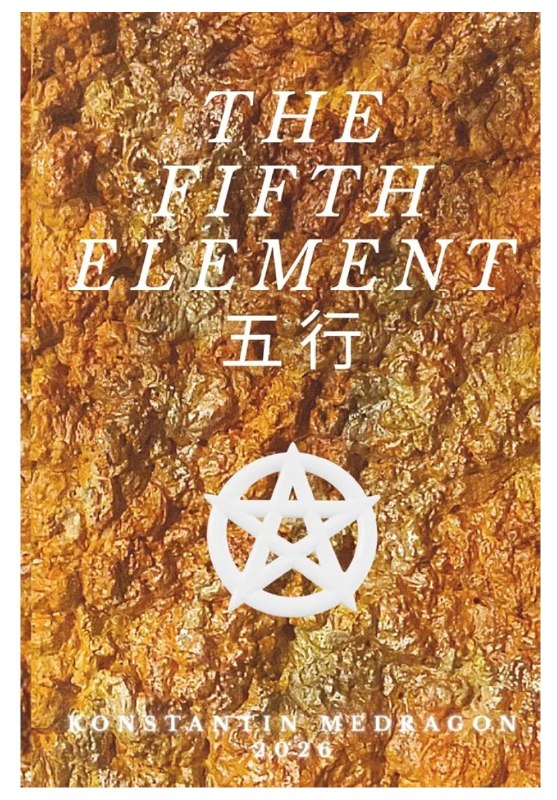
The Fifth Element · 五行
We are born into the language of the Five Elements — knowing them before speech. Ancient knowledge wields this symbolism to map the world's phenomena, revealing how the so-called 'elements' interact. With time, we learn: these elements are but metaphors, describing essences that transcend their literal nature.
The Five Elements dance in two sacred rhythms — Creation and
Constraint. Fire's sacrifice births Earth; Earth's womb bears Metal; Metal weeps Water; Water whispers to the seed of Wood; and Wood sings the spark of Fire anew. Constraint actually represents the five-ray star, used as a recognized sign of government authority. The Control Cycle mirrors nature's silent discipline — Wood's growth tamed by Metal's blade, Earth's stubborn bulk fractured by Wood's roots, Water's boundless flow shackled by Earth's embrace, Fire's wild hunger quenched by Water's kiss, Metal's strength softened by Fire. Here, destruction is not an end, but the art of balance: each element's excess met by its counterforce, weaving order from chaos.
The ritual of control traces a pentagram whose geometry defines the idea of state power. Fifty stars on the US flag, twelve stars of the European Community, five pentagrams forming the celestial scroll of China. Different mythologies hold one truth. The pentagram cycle commands its ritual at the altar of power.
A pentagram is a perfect tool to address the relations between everything in life. The seasons. Everything starts from spring — life manifests itself. This would be the Wood element, as you already guessed. It is also considered that Wood's taste is sour — maybe because it is the taste of brewed food kept long during the winter. Among the five visible planets of the solar system, Wood is associated with Jupiter, the massive giant, the biggest planet of the solar system, the most aggressive one, fed by neighbors which no longer exist. Wood as emotion declares itself as the claim to life. This emotion is, in truth, aggression. The aggressive entitlement to life. If we look at plants, they seize territory. If we look at animals, they reproduce. Even herbivorous animals reproduce in struggle. They fight to reproduce themselves. The whole world proclaims this to you actively through this form, which is connected to determination, aggression, and conquest. Thus, life itself is bound to aggression, and this is the most powerful energy that exists within the five elements. We could continue with the remaining elements, but I want to keep this hidden so as not to disturb your joyful reading of my book.
Now I want to go a little bit further. What if I say that all of you at a certain point are already predetermined by 5 and 12? (Especially those from the US, the EU, and China — the most powerful unions utilizing five-pointed stars as their state authority symbol.) I just spoke about the calendar we all use, and we are used to 12 months in a year. But why exactly 12? Because Earth's closest neighbor — the Moon — has a cycle of about 29 days, which gives roughly 12 lunar months in a year. And the biggest planet in the solar system, Jupiter, has its own year equal to 12 of ours. But this is not the end: an hour and a minute consist of 60 parts, and those 60 are 12 taken five times. Our calendar is boring precisely because minutes, hours, months, and years are plain numbers. China, until now, uses the colorful calendar (the so-called Gan Zhi). Its colors are, as you may guess, the five primal colors which we know before speech — and those you will be introduced to through my paintings.
This book is part of a larger project — a permanent exhibition at Fox Eat Broccoli gallery in Koh Samui, Thailand, where five textured paintings explore the same five elements you will meet in these pages. The book itself is an artifact: its cover reproduces the painting of Earth, the fifth and central element — and the original canvas hangs in the gallery.
Together, the book and the exhibition offer a single language — one that connects organs with emotions, seasons with tastes, planets with sounds, and colors with textures. A language that helps you understand your own life through the five elements, in both psychology and physiology.
And if you are curious — write to me. I can describe your main element, and the story behind it.
- Unfold Your Destiny – ‘Mirror of Fate’ Ba Zi Astrology Course & Tailored Consultations.
- Himalayan pulse. Join us on the roof of the world
- Course "Disease language through tongue"
- Eight Brocades Qigong for longevity and calmness
- Join us on the roof of the world. Himalayan pulse
- My gratitude for unveiling horizons free from didacticism, for boundaries both supple and even translucent.
To read a map with generous latitude is a privilege reserved for those whom fate has endowed with depth.
CatherineCourse student - I regret only one thing: that this was not done before. Perhaps many things would have unfolded differently. Yet, on the other hand, everything happens in its time; it seems the moment of truth has arrived.
In truth, you spoke with clarity and specificity, but I am glad it was not framed as a formula for "eternal bliss" or advice of the "wear green and drink kumis" variety—I feared such platitudes, which leave one feeling confined. Here, instead, there is a sense that the ball is in your hands: you choose how to play, when, or whether to play at all.Some revelations were jarring, yet now I grasp the roots of my own obsessions and hope to navigate life with greater ease, armed with this understanding.
AnastasiaPrivate Consultation -
I wish to express my deepest gratitude to Konstantin for his enlightening Ba Zi course. Thank you for sharing your profound wisdom with such generosity! Konstantin is not only a master of his craft but also a person of remarkable warmth and depth. I feel truly fortunate to have had the opportunity to learn from such a teacher. Now, I eagerly look forward to continuing my studies under his guidance, applying this knowledge to enrich both my own life and the lives of those around me. The journey has only just begun—I cannot wait to dive deeper!
SvetlanaCourse student - I would like to extend my heartfelt gratitude to Konstantin for the profound Ba Zi consultation. His explanation was both thorough and accessible, and I deeply appreciated how he began by illuminating the foundational principles of Ba Zi as a system. What struck me most were the astonishing synchronicities revealed—moments where I had simply thought, “This is how life unfolds,” only to discover that so much of my experience is intricately woven into the very fabric of my chart.
I was equally grateful for the thoughtful, personalized recommendations on balancing its energies—practical yet deeply resonant. To say I am in awe would be an understatement; I will undoubtedly revisit the recording of this session many times to absorb its insights fully. Thank you, Konstantin, with heartfelt thanks 🙏. I eagerly anticipate continuing this journey of learning, and I am certain these teachings will guide me in nurturing not only my own path but also the lives of those around me.
NikaPrivate Consultation