Interpreting ancient Ba Zi manuscripts
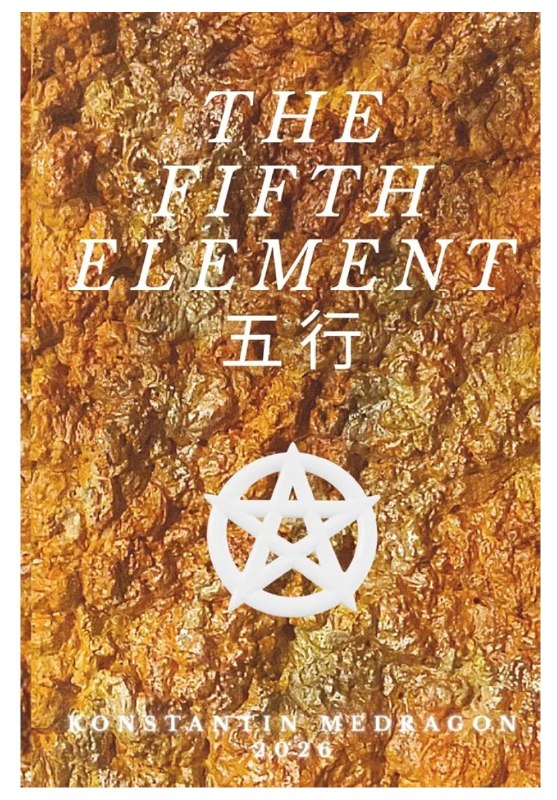
The Fifth Element · 五行
We are born into the language of the Five Elements — knowing them before speech. Ancient knowledge wields this symbolism to map the world's phenomena, revealing how the so-called 'elements' interact. With time, we learn: these elements are but metaphors, describing essences that transcend their literal nature.
The Five Elements dance in two sacred rhythms — Creation and
Constraint. Fire's sacrifice births Earth; Earth's womb bears Metal; Metal weeps Water; Water whispers to the seed of Wood; and Wood sings the spark of Fire anew. Constraint actually represents the five-ray star, used as a recognized sign of government authority. The Control Cycle mirrors nature's silent discipline — Wood's growth tamed by Metal's blade, Earth's stubborn bulk fractured by Wood's roots, Water's boundless flow shackled by Earth's embrace, Fire's wild hunger quenched by Water's kiss, Metal's strength softened by Fire. Here, destruction is not an end, but the art of balance: each element's excess met by its counterforce, weaving order from chaos.
The ritual of control traces a pentagram whose geometry defines the idea of state power. Fifty stars on the US flag, twelve stars of the European Community, five pentagrams forming the celestial scroll of China. Different mythologies hold one truth. The pentagram cycle commands its ritual at the altar of power.
A pentagram is a perfect tool to address the relations between everything in life. The seasons. Everything starts from spring — life manifests itself. This would be the Wood element, as you already guessed. It is also considered that Wood's taste is sour — maybe because it is the taste of brewed food kept long during the winter. Among the five visible planets of the solar system, Wood is associated with Jupiter, the massive giant, the biggest planet of the solar system, the most aggressive one, fed by neighbors which no longer exist. Wood as emotion declares itself as the claim to life. This emotion is, in truth, aggression. The aggressive entitlement to life. If we look at plants, they seize territory. If we look at animals, they reproduce. Even herbivorous animals reproduce in struggle. They fight to reproduce themselves. The whole world proclaims this to you actively through this form, which is connected to determination, aggression, and conquest. Thus, life itself is bound to aggression, and this is the most powerful energy that exists within the five elements. We could continue with the remaining elements, but I want to keep this hidden so as not to disturb your joyful reading of my book.
Now I want to go a little bit further. What if I say that all of you at a certain point are already predetermined by 5 and 12? (Especially those from the US, the EU, and China — the most powerful unions utilizing five-pointed stars as their state authority symbol.) I just spoke about the calendar we all use, and we are used to 12 months in a year. But why exactly 12? Because Earth's closest neighbor — the Moon — has a cycle of about 29 days, which gives roughly 12 lunar months in a year. And the biggest planet in the solar system, Jupiter, has its own year equal to 12 of ours. But this is not the end: an hour and a minute consist of 60 parts, and those 60 are 12 taken five times. Our calendar is boring precisely because minutes, hours, months, and years are plain numbers. China, until now, uses the colorful calendar (the so-called Gan Zhi). Its colors are, as you may guess, the five primal colors which we know before speech — and those you will be introduced to through my paintings.
This book is part of a larger project — a permanent exhibition at Fox Eat Broccoli gallery in Koh Samui, Thailand, where five textured paintings explore the same five elements you will meet in these pages. The book itself is an artifact: its cover reproduces the painting of Earth, the fifth and central element — and the original canvas hangs in the gallery.
Together, the book and the exhibition offer a single language — one that connects organs with emotions, seasons with tastes, planets with sounds, and colors with textures. A language that helps you understand your own life through the five elements, in both psychology and physiology.
And if you are curious — write to me. I can describe your main element, and the story behind it.
Articles
Chinese Calendar History
The earliest known artifacts potentially containing calendrical symbols in China are Neolithic ceramics, dating back to cultures such as:
Yangshao culture (5000–3000 BCE)
Dawenkou culture (4100–2600 BCE)
These painted and incised pottery vessels bear geometric patterns and glyphs that scholars hypothesize may represent early lunar or solar cycles, agricultural calendars, or ritual timekeeping systems
A Dawenkou-era ceramic vessel (大汶口陶尊) bears a glyph, debated to symbolize a solar-lunar calendar.
8 in Chinese Culture - Symbol of Wholeness, Balance, and Cosmic Order
1. The Eight Directions (八方, Bāfāng)
In Chinese geomancy (Feng Shui) and astronomy, space is divided into eight directions, intricately linked to the trigrams of the I Ching and the Five Elements.
«八卦相錯,數往者順,知來者逆»
— Xi Ci Zhuan (Appended Commentary to the I Ching)
“The Eight Trigrams intertwine; to recount the past follows the natural order, to discern the future requires reverse contemplation.”
2. The Eight Trigrams (八卦, Bāguà)
The trigrams of the I Ching form the cornerstone of Chinese cosmology. Each trigram corresponds to an element, a direction, and an aspect of human life.
«八卦成列,象在其中矣»
— Shuo Gua Zhuan (Treatise on the Trigrams)
“When the Eight Trigrams are arrayed in order, all phenomena are contained within them.”
3. The Eight Characters of Ba Zi (八字, Bāzì)
The Four Pillars of Destiny (四柱八字, Sì Zhù Bāzì) system is built on eight characters: two (Heavenly Stem and Earthly Branch) for the year, month, day, and hour of birth.
«八字為命,四柱為體»
— Yuan Hai Zi Ping (Classic Text on Ba Zi Astrology)
“The Eight Characters represent destiny; the Four Pillars form its corporeal foundation.”
Ancient Chinese timekeeping
However, when applying the Ba Zi system and the concept of birth time to individuals born at latitudes far from the equator, these two-hour intervals begin to stretch and compress like rubber. Imagine such a timekeeping system in a place like Arkhangelsk: the Horse hour (午, Wǔ) in winter might last mere minutes instead of two hours, while in summer, it could extend beyond four hours. Therefore, when calculating a chart, it is crucial to use a mathematical model that adjusts for the geographical location and season of birth.
If you wish to determine your true birth hour, feel free to reach out—I am here to assist. Very few modern online Ba Zi calculators offer this essential feature. Keep in mind that these adjustments can significantly influence the balance of the Five Elements and the interpretation of your chart.
Photo ByUser:Sputnikcccp~commonswiki. Own work, CC BY-SA 3.0, https://commons.wikimedia.org/w/index.php?curid=244241
Ba Zi and health
"天有十日,人有十指"
"Heaven has ten [celestial] days [Stems], man has ten fingers."
— Ling Shu
This profound observation reveals the connection between celestial calendar cycles and human anatomy. The idea is further developed in the Basic Questions chapter of the Su Wen:
"肝应甲乙,心应丙丁,脾应戊己,肺应庚辛,肾应壬癸。"
"The Liver corresponds to Jia and Yi, the Heart to Bing and Ding, the Spleen to Wu and Ji, the Lungs to Geng and Xin, the Kidneys to Ren and Gui."
This passage reflects a worldview in which a Bazi chart acts as a personal "blueprint of Universal Qi" —not just mapping external circumstances like Wealth and Social Life, but also Health and emotions. Modern medicine can perform genetic tests to detect disorders before symptoms appear. Bazi operates on a similar principle, but at a subtler level..
The Wisdom of Huainanzi
Thus does the great man (大丈夫, dàzhàngfū) dwell in serenity, free from thoughts and cares. He takes Heaven as his canopy (盖, gài), Earth as his chariot (舆, yú), the seasons as his steeds, and Yin-Yang (阴阳, yīnyáng) as his charioteers. Riding upon clouds, he ascends to celestial heights, following the Creator (造化者, zàohuà zhě) Himself.
He unfurls his thoughts and loosens the reins, soaring through the vast expanse (大区, dàqū). He moves at a trot when a trot is needed, gallops when a gallop is called for. He commands the Lord of Rain (雨师, yǔshī) to bless his path with showers, and the Master of Wind (风伯, fēngbó) to sweep away the dust. Lightning serves as his whip; thunder, the wheels of his chariot.
He ascends to the boundless realms of heaven (霄雿之野, xiāo yáo zhī yě) and descends to the gates of infinity (无垠之门, wúyín zhī mén). His gaze encompasses all that exists, yet he remains whole (全, quán). He wanders the four limits (四隅, sìyú), only to return at last to the primal pivot (枢, shū).
《窮通寶鑑》 The Arcane Mirror of Profound Comprehension
Heaven governs the Five Elements, Earth commands the Five Seasons, and Humanity bears the Five Destinies. The Elements generate and overcome one another in an endless cycle: harmony with them brings prosperity, defiance invites ruin. Wood, Fire, Earth, Metal, and Water each reign in their appointed time and domain. In spring, Wood rises in vigor; summer blazes with Fire’s radiance; autumn sharpens Metal’s edge; winter chills with Water’s stillness, while Earth abides at the center, harmonizing the four directions. Human life mirrors the energies of Heaven and Earth: that which aligns with their rhythm flourishes; that which drifts against their tide withers.
《滴天髓阐微》 The Canon of Heavenly Essence
The horoscope (造, zào) of a certain Wang from the same city. Conventional interpreters, following the principle of "strong body (身强, shēn qiáng) and weak killer (杀浅, shā qiǎn)," selected 庚金 (gēng jīn, Metal) as his "helper deity" (用神, yòng shén). They argued that spring wood (春木, chūn mù), when encountering Metal, would inevitably become "material for beams" (栋梁之器, dòngliáng zhī qì), insisting that if he pursued education, he would surely achieve success. Yet by the age of thirty, not only had he failed academically, but his family’s prosperity had gradually dwindled. He then asked me to analyze his chart.
"观其支坐两寅,乘权当令,干透两壬,生助旺神,年支之辰土,乃水之库,木之余气,能蓄水养木,不能生金,一点庚金,休囚已极,且午火敌之,壬水泄之,不惟无用,反为生水之病。"
I observed that within his Earthly Branches reside two 寅 (yín, Tiger-Wood), positioned in 乘权当令 (chéng quán dāng lìng—dominant and in command). The Heavenly Stems reveal two 壬 (rén, Water), which nourish and amplify the dominant element. The annual branch 辰土 (chén tǔ, Dragon-Earth) acts as a 水之库 (shuǐ zhī kù—reservoir for Water) and retains 木之余气 (mù zhī yúqì—residual Wood energy). While it can accumulate Water and sustain Wood, it cannot generate Metal.
The solitary 庚金 (gēng jīn, Yang Metal) exists in a state of 休囚已极 (xiū qiú yǐ jí—extreme weakness and decay). Further weakened by the opposition of 午火 (wǔ huǒ, Horse-Fire) and drained by 壬水 (rén shuǐ, Yang Water), this Metal not only proves futile but becomes a 病 (bìng—pathogenic factor), exacerbating Water’s disruptive influence.
"大凡旺之极者,宜泄而不宜克,宜顺其气势,弗悖其性也。以午火为用,将来至火地,虽不贵于名,定当富于利,可弃名就利,如再守芸窗,终身误矣。"
When an element becomes excessively strong (旺之极者, wàng zhī jí zhě), the proper approach is to weaken it (泄, xiè) rather than suppress it (克, kè). One must follow its innate energy (顺其气势, shùn qí qìshì), not oppose its nature. For this chart, 午火 (wǔ huǒ, Horse-Fire) should be chosen as the "helper deity" (用神, yòng shén). In future Fire phases (火地, huǒ dì), he may not achieve renown (贵于名, guì yú míng) but will undoubtedly attain wealth (富于利, fù yú lì). He must abandon the pursuit of prestige and focus on profit. If he persists in clinging to scholarly pursuits (守芸窗, shǒu yún chuāng), he will waste his life in vain.
He heeded the advice, abandoned scholarly ambitions (弃儒, qì rú), and turned to commerce. When the 丙午 (bǐng wǔ, Fire) phase arrived—utterly subduing the harmful 庚金 (庚金之病, gēng jīn zhī bìng)—he amassed over a hundred thousand in wealth (发财十余万, fācái shí yú wàn) in less than a decade. This conclusively proved that 庚金 (gēng jīn) had indeed acted as the pathogenic factor (病, bìng) in his chart.
"彼即弃儒就经营,至丙午运,克尽庚金之病,不满十年,发财十余万,则庚金为病明矣。"
He heeded the advice, abandoned scholarly ambitions (弃儒, qì rú), and turned to commerce. When the 丙午 (bǐng wǔ, Fire) phase arrived—utterly subduing the harmful 庚金 (庚金之病, gēng jīn zhī bìng)—he amassed over a hundred thousand in wealth (发财十余万, fācái shí yú wàn) in less than a decade. This conclusively proved that 庚金 (gēng jīn) had indeed acted as the pathogenic factor (病, bìng) in his chart.
《太上玄靈北斗本命延生真經》
The supreme mysterious numinous scripture of the Northern Dipper for extending life according to One’s Natal Destiny
The Jiazi Day (甲子日) is especially auspicious for performing the "Li Dou" (Ritual of Worship to the Dipper).
Taoism teaches that a person’s soul and destiny are governed by the Doufu (斗府) – the celestial palace of the Northern Dipper (北斗, Běidǒu, the Big Dipper). The "Dou" (斗) refers to the constellation ruling one’s personal fate. Each person is born under the influence of one of the Seven Stars of the Northern Dipper (北斗七星) and has a corresponding "Benming Xingjun" (本命星君, Star Lord of Natal Destiny). The "Li Dou" ritual performed on Jiazi Day venerates these celestial protectors and seeks their blessings.
Identifying Your Benming Xingjun (本命星君)
北斗七星,在人身中,為之七魄。
第一陽明星,第二陰精星,第三真人星,第四玄冥星,第五丹元星,第六北極星,第七天關星。
各主其命,各司其職
«“The Seven Stars of the Northern Dipper correspond to the Seven Souls (Po) within the human body:
First: Yangming Xing (Star of Bright Light),
Second: Yinjing Xing (Star of Hidden Essence),
Third: Zhenren Xing (Star of the True Human),
Fourth: Xuanming Xing (Star of Mysterious Darkness),
Fifth: Danyuan Xing (Star of Cinnabar Origin),
Sixth: Beiji Xing (Star of the Northern Pole),
Seventh: Tianguan Xing (Star of Celestial Gates).
Each governs destiny and fulfills its duty.”».
Practice:
By consulting ancient records and calculating their birth chart, the adept identifies their Benming Xingjun:
- Born in 子 (Rat), 午 (Horse), 卯 (Rabbit), 酉 (Rooster) years → Yangming Xingjun (1st Star)
- Born in 寅 (Tiger), 申 (Monkey), 巳 (Snake), 亥 (Pig) years → Yinjing Xingjun (2nd Star)
- Born in 辰 (Dragon), 戌 (Dog), 丑 (Ox), 未 (Goat) years → Zhenren Xingjun (3rd Star)
- *Note: Stars 4–7 are assigned via birth month/day/hour or ritual context.
北斗真君,能解一切厄:
三災厄、四煞厄、五行厄、夫妻厄……
但能虔誠禮斗,無願不從。
«The True Lord of the Northern Dipper resolves all calamities:
Disasters of Three [Heaven/Earth/Human],
Misfortunes of Four Baleful Stars,
Imbalances of Five Elements,
Marital Strife…
If one worships the Dipper with sincerity,
No prayer shall go unanswered.».
Opening Incantation (開經玄蘊咒)
寂寂至無宗。
In utter silence, beyond all origin.
虚峙劫仞阿。
Void-standing, Mount Sumeru spans the kalpas.
豁落洞玄文。
Scriptures of Huoluo pierce the Mysterious Depths.
誰測此幽遐。
Who can fathom this profound darkness?
一入大乘路。
Once treading the Great Vehicle’s path,
孰計年劫多。
Who counts the years or kalpas?
不生亦不滅。
No birth, no death.
欲生因蓮花。
The will to live blooms from the Lotus.
超凌三界途。
Soaring beyond the Three Realms,
慈心解世羅。
A heart of compassion shreds worldly snares.
真人無上德。
The True Human’s virtue is supreme,
世世為仙家。
Life after life, immortal they dwell.
- Unfold Your Destiny – ‘Mirror of Fate’ Ba Zi Astrology Course & Tailored Consultations.
- Course "Disease language through tongue"
- Eight Brocades Qigong for longevity and calmness
- Join us on the roof of the world. Himalayan pulse